AI4Testing vs Testing AI: Two Different QA Strategies Explained
Compare AI4Testing with Testing AI through scope, ownership, evidence, examples, risks, metrics, and a practical decision model for QA teams in 2026.
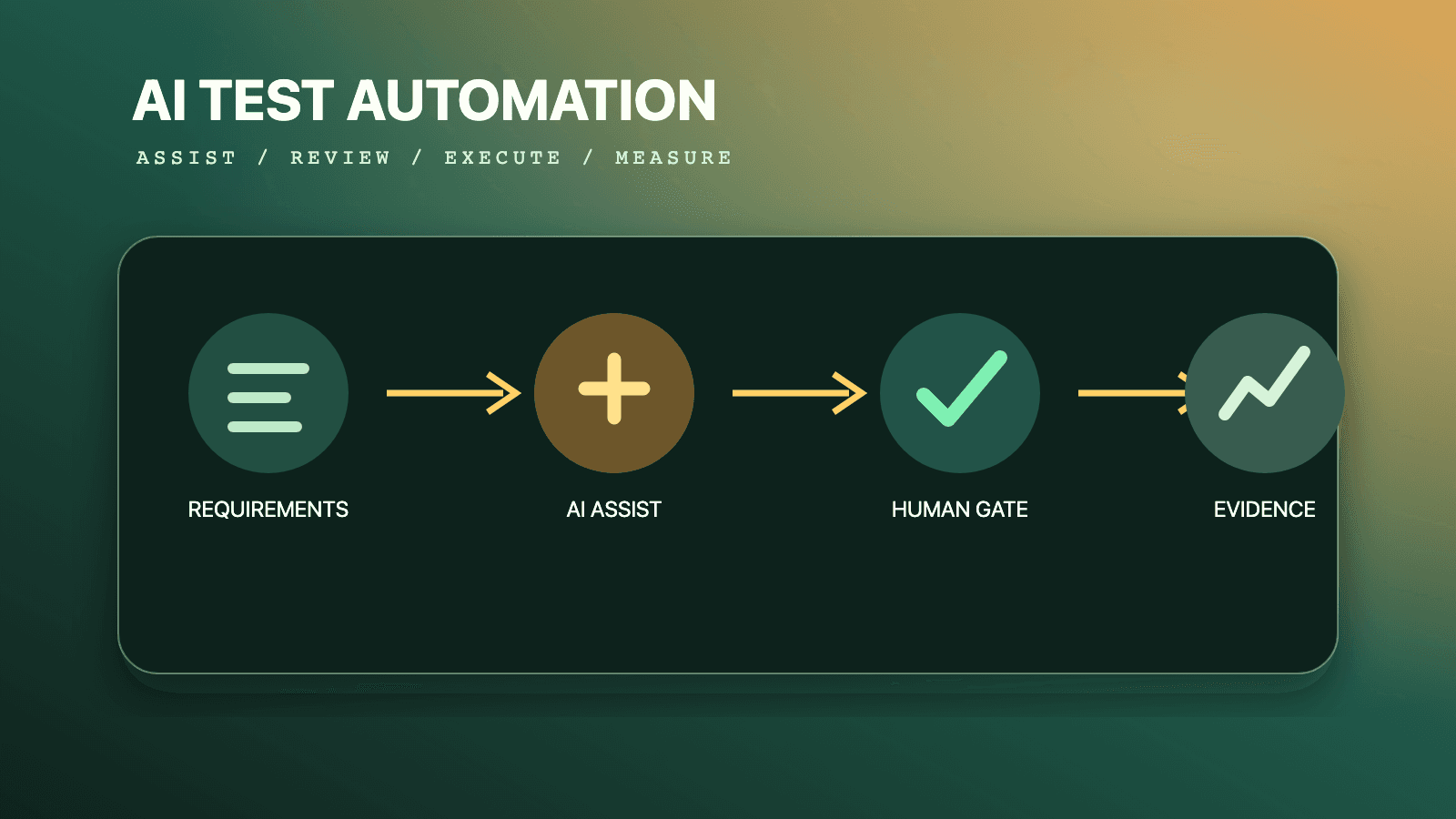
AI4Testing vs Testing AI is a direction-of-use distinction. AI4Testing uses AI to improve the testing process: planning cases, generating automation, analyzing failures, or proposing repairs. Testing AI evaluates an AI-based product: its data, model, outputs, robustness, fairness, security, and behavior in operation. One is a test capability; the other is a test target. The AI test automation tools pillar covers the broader landscape. This guide gives QA leaders a clean boundary, an evidence model, and a way to run both strategies without confusing faster test creation with proof that an AI system is trustworthy.
The distinction became sharper in 2026. ISTQB's CT-AI v2 release removed content about using AI for testing and now focuses exclusively on testing AI-based systems. ISTQB points the first use case toward CT-GenAI. This is a curriculum boundary, not a rule that one team cannot do both.
Fast Boundary Check
| Decision question | AI4Testing | Testing AI | If both are present |
|---|---|---|---|
| What is the AI's role? | Assistant, generator, classifier, or repair mechanism in QA work | Component or behavior of the product under test | Draw two system boundaries and two risk registers |
| Primary outcome | Faster or more effective test work | Evidence that an AI-based system meets context-specific requirements | Never use productivity evidence as product assurance |
| Typical inputs | Requirements, code, DOM state, tests, logs, traces | Datasets, labels, prompts, model/version, configurations, user context | Control provenance and sensitive data separately |
| Typical oracle | Existing requirement, executable test, reviewer decision | Statistical threshold, property, relation, reference, human rubric | Preserve independent expected results |
| Main failure risk | Bad tests, missed defects, unsafe edits, false triage | Harmful, biased, insecure, drifting, or unreliable product behavior | Escalate failures to different owners |
| Core owner | QA automation or developer productivity team | Product, ML, data, safety, security, and QA jointly | Name one accountable owner for each decision |
| Release evidence | Review records, test quality, pipeline outcomes, tool audit trail | Versioned TEVV results tied to deployment context | Keep artifacts linked but not merged into one score |
Use the first row when terminology becomes vague: if removing the AI capability would remove only a QA helper, it is probably AI4Testing. If removing it would materially change the product's behavior for a user, it is Testing AI. An AI feature can also occupy both roles in one organization, but not in the same evidence claim.
Strategy One: AI4Testing Improves How Tests Are Produced or Operated
AI4Testing applies an AI system inside the testing lifecycle. Examples include turning a requirement into a draft test plan, generating a Playwright test, classifying CI failures, clustering duplicate defects, proposing a locator repair, producing test data, or summarizing a trace. The application under test can be completely deterministic; the AI is in the QA toolchain.
Success is not "the model produced an answer." Success is an improvement in a test outcome with controlled risk. Useful outcome measures include review acceptance, escaped defects in the affected area, false triage decisions, time to reliable diagnosis, test mutation sensitivity, flaky-test rate, and changes to delivery stability. The measure must match the job. Counting generated test files rewards volume even when assertions are weak.
Official Playwright Test Agents are a concrete current example. The Playwright agent documentation defines a planner that explores an application and writes a Markdown plan, a generator that turns a plan into Playwright tests while checking selectors and assertions live, and a healer that runs and repairs failing tests. These agents are AI4Testing because they change how conventional web tests are planned, implemented, and maintained.
AI4Testing still creates product risk. A generated test can assert the implementation instead of the requirement. A failure classifier can hide a regression as "infrastructure." A repair agent can weaken an assertion or skip a broken scenario. The SDET remains responsible for the test oracle, scope, evidence, and merge decision. Use the AI-generated code review playbook when the assistant writes code, and the self-healing governance guide when it proposes repair.
Strategy Two: Testing AI Evaluates the AI-Based Product
Testing AI starts with a different system under test. A learned classifier, recommendation service, computer-vision component, adaptive control, LLM feature, RAG application, or tool-using agent influences user outcomes. The test strategy must account for data dependence, probabilistic or non-deterministic outputs, weak or expensive oracles, operational drift, and context-specific harm.
The ISTQB CT-AI v2 syllabus organizes this work across input data testing, model testing, system testing, GenAI and LLM testing, and ML development testing. It names techniques such as bias and label-correctness testing, statistical testing, red teaming, metamorphic testing, drift testing, back-to-back testing, A/B testing, and adversarial testing. The correct technique depends on risk; listing all of them is not a strategy.
NIST uses the broader term testing, evaluation, verification, and validation, or TEVV. Its AI RMF Core calls for objective, repeatable, or scalable TEVV processes, documented test sets, metrics, tools, deployment-relevant conditions, production monitoring, and stated limits on generalizability. NIST's TEVV program also emphasizes that measurement changes with operating context. That means a benchmark score detached from users and deployment is insufficient product evidence.
Testing AI asks questions AI4Testing usually does not:
- Which people, conditions, languages, and edge cases are represented in the input and evaluation data?
- Which model, prompt, retrieval corpus, policy, tool set, and configuration produced this result?
- What variation is expected across repeated runs, and what variation is unacceptable?
- Which harms require adversarial, subgroup, safety, privacy, or security evaluation?
- How will drift, incidents, appeals, and feedback trigger reevaluation after release?
The ISTQB CT-AI v2 guide maps those questions to the 2026 syllabus. For implementation beyond certification scope, the canonical testing LLM applications guide covers application-level evaluation patterns.
Example A: AI4Testing with Playwright Planner, Generator, and Healer
Assume a conventional todo application uses deterministic application code. A team wants AI to accelerate browser-test creation without allowing autonomous merges. The executable example below uses Playwright's public TodoMVC demo rather than an invented application API.
First, generate the official agent definitions for the chosen client. Playwright says to regenerate them whenever Playwright is updated because the definitions contain current instructions and tools:
npx playwright init-agents --loop=codex
Then run a controlled sequence:
- Give the planner a seed test, the todo behavior, the allowed public demo target, and a bounded request such as add, complete, and filter one item.
- Review the Markdown plan for omitted negative paths, destructive actions, and incorrect expected results.
- Let the generator produce tests only from the approved plan.
- Review locators and assertions against Playwright's recommendation to test user-visible behavior and use resilient locators.
- Run the suite in an isolated environment with trace and failure artifacts.
- If the healer proposes a patch, compare intent before and after, inspect every changed file, and rerun the unmodified acceptance assertions.
The resulting test might contain:
import { test, expect } from '@playwright/test';

test('completed filter retains the completed item', async ({ page }) => {
  await page.goto('https://demo.playwright.dev/todomvc/');
  const input = page.getByPlaceholder('What needs to be done?');
  await input.fill('Buy groceries');
  await input.press('Enter');

  const item = page.getByRole('listitem').filter({ hasText: 'Buy groceries' });
  await item.getByRole('checkbox').check();
  await page.getByRole('link', { name: 'Completed' }).click();

  await expect(item).toBeVisible();
  await expect(item.getByRole('checkbox')).toBeChecked();
});
This is AI4Testing even if an agent planned and generated every line. The expected filter behavior comes from the application contract, not from the agent. A passing generated test is evidence about the todo behavior only after the team validates that the scenario and assertions represent the requirement.
Example B: Testing an AI Ticket-Routing Model
Now assume the product itself predicts which support queue should receive a ticket. The AI changes a customer's wait path, so the test target includes data, model, integration, and operational behavior.
The team defines deployment-aware acceptance criteria before evaluating the model:
- A versioned held-out set reflects supported products, regions, languages, and ticket types.
- Results are reported per queue and critical subgroup, not only as one aggregate.
- High-risk abuse and account-access tickets have explicitly reviewed false-negative tolerances.
- A metamorphic check verifies that normalization-only changes, such as harmless surrounding whitespace, do not change routing.
- API tests reject unsupported schemas and preserve traceable model/version metadata.
- Production monitoring looks for input distribution and outcome changes that trigger review.
A test record should identify the dataset version, model artifact, preprocessing code, configuration, metric definitions, confidence or uncertainty treatment, and decision owner. If the model improves aggregate accuracy while degrading the account-access queue beyond its approved tolerance, it fails. A test-generation assistant may help create scripts for those checks, but that helper does not change the fact that this is Testing AI.
Why the Evidence Models Must Stay Separate
AI4Testing evidence answers "Can we trust this assisted testing workflow enough for its permitted use?" Testing AI evidence answers "Does this AI-based product meet requirements and remain within risk tolerance in its deployment context?" They overlap in governance mechanics but not in conclusion.
For AI4Testing, preserve prompts or task instructions where policy permits, tool and model versions, input scope, proposed changes, reviewer decisions, test outcomes, and incidents such as unsafe edits. For Testing AI, preserve data/model lineage, evaluation design, reference decisions, segmented results, uncertainty, red-team findings, residual risks, release approval, and production feedback.
A common anti-pattern is circular assurance: an AI agent writes product code, writes the tests, repairs the tests, summarizes the run, and declares release readiness. OWASP's Secure Coding with AI guidance warns that an agent can make CI green by weakening assertions, deleting tests, or testing the generated behavior rather than the correct behavior. Independent expected results and review break the circle.
Build a Two-Lane QA Operating Model
Lane A: govern AI-assisted testing as a toolchain capability
Inventory approved use cases. Define what data the assistant may receive, which repositories and commands it may access, whether output can be committed, and which changes always require specialists. Establish a small evaluation set of representative QA tasks and known traps. Measure outcomes, not prompt fluency.
The QASkills directory can provide explicit testing instructions for coding agents. The Playwright CLI skill supports auditable browser interaction. Skills improve task context; they do not grant correctness, permission, or independent review.
Lane B: govern the product AI across its lifecycle
Map the intended purpose, affected users, foreseeable misuse, data and model supply chain, human decisions, and operational environment. Derive testable acceptance criteria from that map. Execute data, model, integration, system, adversarial, and production evaluations proportional to risk. Define rollback, fallback, incident, and reevaluation triggers before launch.
Connect the lanes through controlled handoffs
An AI4Testing assistant may generate dataset checks or Playwright journeys for an AI product. Mark generated artifacts, review them against the Testing AI strategy, and execute them in the product evidence pipeline. The artifact can move between lanes; accountability does not. The product's release owner cannot cite "the assistant wrote 200 tests" as proof of quality.
Use DORA as a Delivery Guardrail, Not an AI Scoreboard
DORA's 2025 State of AI-assisted Software Development describes AI as an amplifier of an organization's existing strengths and weaknesses. Its 2026 Impact of Generative AI in Software Development recommends strong, fast feedback loops including automated testing and code review because AI can generate large amounts of code rapidly.
For AI4Testing, track whether the capability improves reviewable throughput without degrading stability, rework, or escaped quality. For Testing AI, delivery metrics remain useful for the surrounding software process, but they do not replace model and system quality measures. A low change-failure rate says nothing by itself about subgroup harm or unsafe model outputs.
Run a balanced review monthly:
- Delivery: change lead time, deployment frequency, failed deployments, recovery, and rework in the affected service.
- Test capability: accepted versus rejected suggestions, false triage, flaky behavior, mutation sensitivity, and reviewer effort.
- Product AI: deployment-specific quality, safety, security, fairness, drift, incidents, and user feedback.
Correlate carefully. Do not claim causation from a short before/after window, and do not blend the categories into a single "AI quality" number.
Concrete Failure Paths
The team buys an AI test generator to solve model bias
The tool may help implement checks, but it cannot define represented populations, harm, or acceptance thresholds. Recovery: create a Testing AI risk and data strategy first, then use AI4Testing only for bounded execution support.
A model benchmark becomes the release oracle
The benchmark may not reflect the product's data, workflows, or harms. Recovery: validate under deployment-like conditions, segment outcomes, test integrations, document generalization limits, and monitor operation as the NIST AI RMF recommends.
A healer changes a failing expected result
The test becomes green by adopting current behavior. Recovery: block automatic assertion changes, compare against an independently approved requirement, inspect the diff, and treat changed product semantics as a defect or requirement decision.
Every probabilistic variation is labeled flaky
Expected model variability and test-environment instability are different phenomena. Recovery: characterize repeated-run distributions, fix randomization controls where appropriate, define tolerances before execution, and keep infrastructure failures in a separate taxonomy.
One "AI QA team" owns everything
The group becomes a bottleneck and lacks authority over data, product harm, security, and release. Recovery: use a cross-functional Testing AI model while keeping an enablement owner for AI4Testing tools. Assign accountability per decision, not per buzzword.
A Practical Adoption Sequence
Label one backlog before buying another tool
Take a representative sprint backlog and mark each AI-related item as tool, target, or both. "Generate checkout tests" is tool-side AI4Testing. "Evaluate recommendation diversity by user context" is target-side Testing AI. "Use an agent to generate those evaluation scripts" is both and needs a handoff. For every item, add an owner, expected evidence, prohibited data, independent oracle, and stop condition. Items that cannot be classified expose missing architecture or accountability. This exercise is more useful than debating terminology in isolation because it changes access, review, test design, and release evidence before implementation begins.
Start AI4Testing with a reversible, reviewable task such as drafting plans or summarizing traces. Establish a baseline, evaluate on representative tasks, require human approval, and expand permissions only when evidence supports it. Avoid beginning with autonomous test deletion, production data, or release decisions.
Start Testing AI at product discovery, not after model integration. Map intended use and harm, define data and evaluation needs, reserve independent test assets, instrument version lineage, and set production monitoring before release. The order matters because evaluation cannot recover missing provenance or an evaluation set repeatedly used for tuning.
When both begin together, create the two-lane artifact model on day one. Label which AI is the tool and which AI is the target in architecture diagrams, tickets, tests, dashboards, and incident records. That small naming discipline prevents expensive evidence confusion later.
Version and Terminology Limitations
This comparison is current to July 14, 2026. "AI4Testing" and "Testing AI" are useful directional labels, but organizations and standards may use "AI for testing," "testing of AI," "AI-assisted testing," or TEVV. Define terms locally instead of assuming a vendor's category has the same boundary.
ISTQB CT-AI v2.0 is the current cited syllabus; v1.0 remains temporarily available under published sunset dates. NIST states that AI RMF 1.0 is voluntary and is being revised, so verify the current framework before using it in policy. Playwright's agent definitions evolve with releases; official documentation says to regenerate them whenever Playwright is updated. None of these sources supplies a universal acceptance threshold or removes applicable legal, safety, privacy, and domain obligations.
Frequently Asked Questions
1. What is the simplest difference between AI4Testing and Testing AI?
AI4Testing makes testing work more capable or efficient by using AI. Testing AI examines an AI-based product or component. Ask whether AI is primarily inside the QA toolchain or inside the behavior delivered to users.
2. Is automated testing of an ML API AI4Testing or Testing AI?
It is Testing AI because the API under test exposes learned behavior. If an AI assistant generates the API tests, that generation step is also AI4Testing. One workflow can therefore contain both directions.
3. Are Playwright Test Agents an example of Testing AI?
Not when they plan, generate, or heal tests for a conventional web application. In that role they are AI4Testing. Testing the agents themselves for unsafe or incorrect behavior would be Testing AI.
4. Which strategy does ISTQB CT-AI v2 teach?
CT-AI v2 teaches testing AI-based systems. It removed AI used to support conventional testing. ISTQB points candidates interested in generative AI applied during testing toward CT-GenAI.
5. Can one QA engineer specialize in both directions?
Yes, but the competency mix differs. AI4Testing emphasizes automation architecture, review, tool governance, and feedback loops. Testing AI additionally requires data, statistical, model, socio-technical risk, adversarial, and production-monitoring skills.
6. Does a high automated-test count prove an AI product is safe?
No. Test count does not establish oracle quality, deployment relevance, subgroup coverage, robustness, security, or residual risk. Product assurance needs traceable, risk-based evidence and documented limitations.
7. Where should a QA team start in 2026?
For AI4Testing, start with a low-permission, reviewable task and measure an outcome against a baseline. For Testing AI, start by mapping intended use, affected people, failure impact, data, and deployment context before selecting techniques or tools.