Self-Healing Test Automation Governance for Reliable QA Suites
Govern self-healing test automation with eligibility rules, human review, audit evidence, stop conditions, safe examples, rollout phases, and reliability metrics.
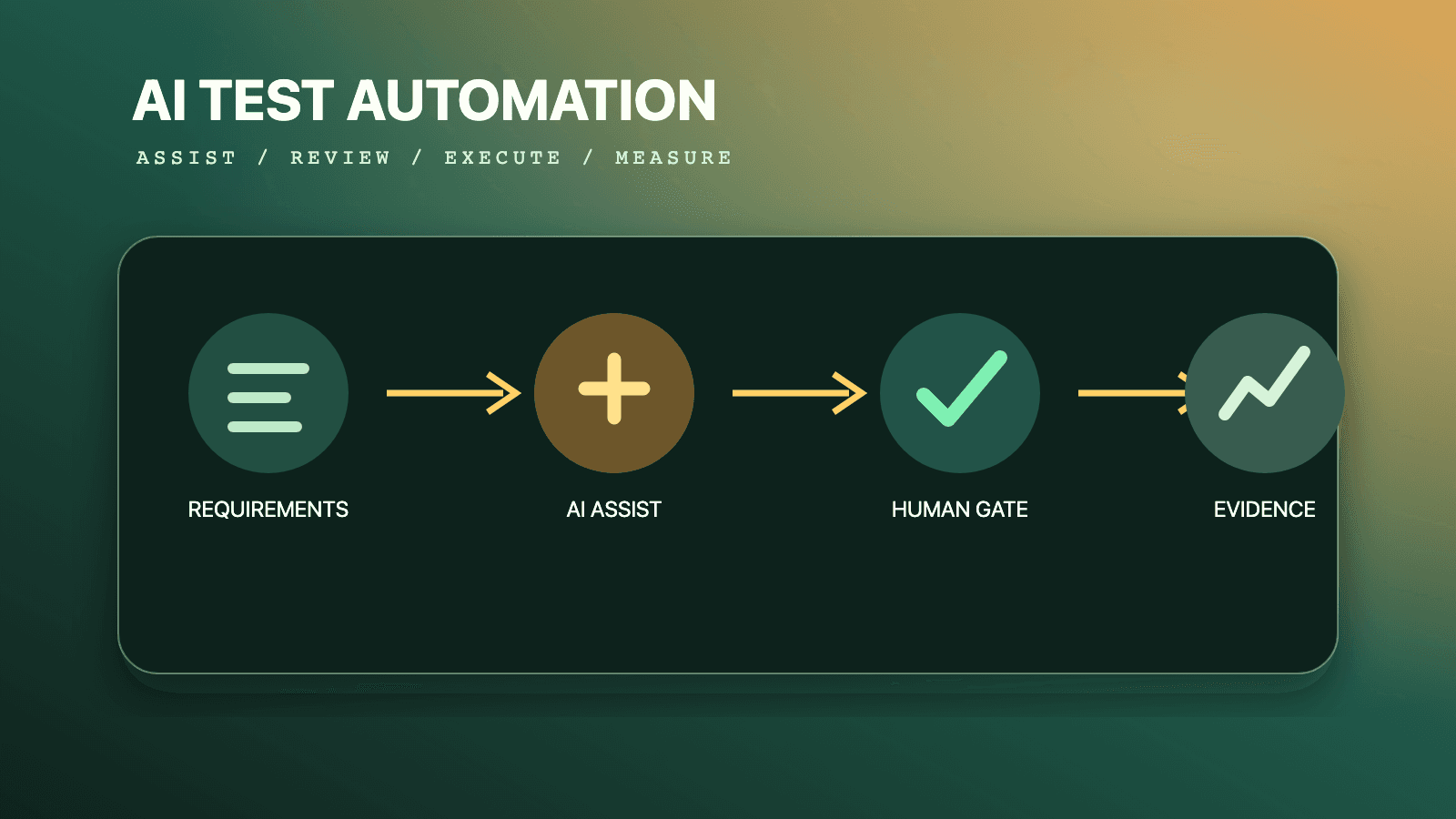
Self healing test automation is reliable only when healing produces a reviewable candidate, preserves the test's independently approved intent, captures before-and-after evidence, reruns the relevant suite, and stops when product behavior may have changed. Auto-accepting any patch that turns red into green can hide regressions. Start with resilient test design, then permit narrow locator or synchronization repairs under policy. The AI test automation tools pillar places healing among wider AI-assisted workflows; this guide defines governance, decision rights, failure paths, rollout controls, and audit records for production QA suites.
"Healing" is not one technology. A framework may retry a current locator against a fresh DOM, rank stored alternative selectors, propose a code patch from failure evidence, adjust test data, or ask an agent to replay a user flow. Those mechanisms have different authority and risk. A retry that observes the same intended button is not equivalent to changing an expected result or skipping a scenario.
This is AI used for testing, outside the narrowed CT-AI v2 certification scope. The ISTQB CT-AI v2 guide explains that 2026 boundary for teams that also test AI-based products.
Define Healing by What It May Change
A useful definition is: controlled repair of test implementation after the original test can no longer execute its unchanged intent against an authorized product state. Three constraints matter.
First, the expected behavior remains externally defined. Second, the repair changes test mechanics, not the product oracle. Third, the process leaves enough evidence for another person to reproduce and reject the decision.
Do not label these actions as healing:
- changing "access denied" to "access granted" because the application now grants access;
- deleting or skipping a failing security, payment, or safety scenario;
- increasing retries until a race passes often enough;
- mocking the dependency the test was intended to exercise;
- updating a visual baseline without inspecting the changed pixels and requirement;
- changing production data to match an assertion;
- broadening a locator until it clicks an arbitrary matching element.
OWASP's Secure Coding with AI Cheat Sheet explicitly warns that AI agents can make CI green by deleting tests, weakening assertions, adding inappropriate mocks, or asserting buggy behavior. Healing governance exists to prevent that false-green path.
Decide Eligibility Before a Failure Occurs
| Failure category | Automatic action allowed | Human-reviewed candidate allowed | Mandatory stop condition |
|---|---|---|---|
| Transient observation with unchanged state | Framework's documented auto-waiting within the existing timeout | Timing diagnosis or event-based wait patch | Repeated timeout, unknown state, or increased timeout without cause |
| Locator implementation drift | Re-resolve a lazy semantic locator | Minimal move from brittle DOM selector to approved role, label, or test contract | Ambiguous target, changed accessible meaning, or destructive action |
| Test data fixture drift | None unless data regeneration is deterministic and preapproved | Fixture update with schema and provenance evidence | Production data, changed business rule, privacy concern, or hidden dependency |
| Environment or dependency failure | Retry only under existing bounded infrastructure policy | Isolation, mock, or environment fix reviewed by owner | Product failure is indistinguishable from environment failure |
| Assertion or expected output mismatch | None | Requirement-owner decision followed by normal test change | Healer proposes changing, deleting, weakening, or skipping the oracle |
| Authorization, money, migration, security, safety | Evidence collection only | Specialist-reviewed minimal patch | Any behavior change, missing audit evidence, or uncertain blast radius |
The table is a starting control, not vendor configuration. Tailor it to consequence. A marketing-page locator can tolerate a different approval path from a button that transfers funds. Record eligibility per suite, tag, directory, or risk class so the policy is executable rather than tribal knowledge.
Prevent Failures Before Adding a Healer
The cheapest heal is a failure that robust test design avoids. Playwright's official locator guidance says locators are central to auto-waiting and retryability and recommends user-facing attributes or explicit test contracts. Its best-practices guide recommends testing user-visible behavior, isolating tests, and preferring resilient locators over DOM implementation details.
Use this priority intentionally:
- Accessible role and name for user interactions whose semantics matter.
- Label, placeholder, visible text, or alternative text where appropriate.
- A stable test ID as an explicit contract where user-facing semantics are insufficient.
- Compact CSS only when no stronger contract is available.
- Avoid long CSS and XPath chains tied to DOM structure.
Selenium's official locator practice similarly recommends unique, predictable IDs when available, compact readable selectors, and avoiding expensive or difficult DOM traversal. Framework preferences differ, but both sources reward stable, understandable contracts over positional structure.
Also remove false timing failures before invoking AI. Playwright performs documented actionability checks before actions such as a click. Web-first assertions retry their condition. Adding a fixed sleep around those mechanisms usually increases duration while preserving the race. Diagnose network, animation, state, and event completion instead.
The canonical Playwright best practices guide provides broader suite design context, and fixing flaky tests separates nondeterministic failures from repairable implementation drift. For a wider maintenance program beyond governance, continue to AI test maintenance and self-healing strategies.
Example 1: A Safe Locator Repair Candidate
Suppose an old test uses a CSS class owned by the design system. A redesign changes wrappers and classes, but the requirement remains: a user saves a valid profile and sees confirmation.
Before:
await page.locator('.profile-actions > button.primary').click();
await expect(page.locator('.toast-success')).toHaveText('Profile saved');
A repair candidate uses the unchanged user-visible contract:
await page.getByRole('button', { name: 'Save profile' }).click();
await expect(page.getByRole('status')).toHaveText('Profile saved');
Approve only after the evidence shows one unique target, the action still submits the same profile operation, the confirmation semantics remain required, and neighboring save/cancel/error tests pass. The patch removes implementation coupling without weakening intent. It is still a code review, not an invisible runtime substitution.
If the application has two "Save profile" buttons in different forms, the candidate is ambiguous. Scope it through an approved dialog or form landmark, or add an explicit test contract. Never select .first() merely to make strictness errors disappear.
Create a Tool-Neutral Healing Policy
Write policy before configuring a product. The following YAML is an internal governance example, not a Playwright or Healenium API:
policyVersion: 1
defaultMode: observe
eligibleChanges:
  - locator-mechanics
  - event-based-synchronization
forbiddenChanges:
  - assertions
  - test-skip-status
  - production-code
  - security-fixtures
approval:
  locator-mechanics: qa-owner
  high-risk-suite: qa-owner-and-domain-owner
limits:
  maxCandidateFiles: 1
  maxAttemptsPerFailure: 2
evidence:
  - original-error
  - trace-or-dom-state
  - proposed-diff
  - targeted-rerun
  - required-regression-run
Numerical limits here illustrate bounded control, not universal best values. Choose them from suite risk and operating experience. Version the policy, review changes, and associate every decision with the version used.
The default mode should be observe during adoption: produce classification and evidence without modifying files or run outcomes. Move a narrow failure class to propose after reviewers agree classifications are useful. Use auto-apply only for deterministic, reversible changes whose unchanged assertions and required suite still run, and never equate auto-apply with auto-merge.
Make the Healing Workflow a State Machine
State 1: fail normally
Run the test without hidden rescue. Capture the original error, test identity, source revision, environment, browser/driver, data version, and attempt. Preserve the first failure because later retries can erase diagnostic state.
State 2: classify
Determine whether the failure is product regression, test defect, data, environment, dependency, timing, locator drift, or unknown. Use evidence, not the healer's confidence label alone. Unknown and mixed failures escalate.
State 3: check eligibility
Apply risk, suite, change-type, and environment policy. Confirm that the test intent and assertion are immutable for this healing attempt. Disallow repair when the product contract changed or ownership is unclear.
State 4: propose a minimal candidate
The candidate should contain the smallest test-only change that restores execution. Include rationale and alternatives considered. Do not bundle refactoring, dependency updates, broad formatting, or product changes.
State 5: verify independently
Rerun the target from clean state, relevant neighboring tests, and the policy-required regression set. Compare observables before and after. For browser failures, use traces, screenshots, network, console, and DOM/accessibility state. Playwright's Trace Viewer can inspect actions, snapshots, logs, errors, console, and network from a captured trace.
State 6: approve, reject, or escalate
A named reviewer decides. Rejection should retain the candidate and reason so repeated bad proposals can improve policy. Approval creates a normal reviewed change. Escalation opens a product defect, requirement question, environment incident, or specialist review.
State 7: monitor after merge
Track recurrence and nearby failures. A patch that moves breakage to another test is not a successful heal. Repeated healing in one component is feedback to improve application testability or selector contracts.
The Minimum Audit Record
Every proposed repair should answer:
- Which source revision, test, project, environment, and data failed?
- What was the first unmodified failure and artifact location?
- How was the failure classified, with what uncertainty?
- Which policy version and eligibility rule permitted a proposal?
- What exact files, locators, waits, fixtures, or assertions changed?
- Did assertion count, text, snapshots, skip status, retries, or timeout change?
- Which targeted and regression runs executed, and what were their results?
- Who approved, rejected, or escalated, when, and why?
- What limitation or follow-up remains?
Store durable references rather than embedding secrets or sensitive page content in logs. Apply normal retention, access, and privacy rules to screenshots, traces, prompts, DOM snapshots, and test data.
Example 2: A Failure the Healer Must Not Repair
A test requires permanent account deletion after reauthentication. The product now shows "Deactivate account," retains data, and omits reauthentication. A healer finds the new button, changes the expected confirmation to "Account deactivated," and passes.
That proposal changes three product semantics: reversibility, retention, and authorization friction. The correct flow is to stop, preserve artifacts, and open a requirement/security review. If the product intentionally changed, owners must update requirements, privacy behavior, threat analysis, and tests through the normal process. If it did not, the test found a regression.
The same stop rule applies when:
- a 403 becomes 200;
- a payment amount or currency changes;
- a validation error disappears;
- an audit event is absent;
- a destructive action targets a different object;
- the only passing route is to skip or weaken the assertion.
Confidence in element similarity cannot answer whether behavior is acceptable. The oracle owner must.
Govern Official Playwright Test Agents Deliberately
Playwright's Test Agent documentation defines planner, generator, and healer agents. The healer replays failing steps, inspects current UI, suggests a patch such as a locator, wait, or data fix, and reruns until the test passes or guardrails stop the loop. Its documented output can also be a skipped test if it believes functionality is broken.
That last outcome is a governance trigger. A skipped critical test can make a run appear less red while coverage disappears. CI should surface newly skipped tests, and reviewers should compare skip state before and after every healing attempt.
Use official agents safely:
- Generate agent definitions with the documented
npx playwright init-agents --loop=<client>command. - Regenerate definitions whenever Playwright is updated, as the docs instruct.
- Keep human-readable plans and expected results under review.
- Restrict healer write scope and credentials in the host agent.
- Preserve the original failure and inspect every proposed file change.
- Block assertion, skip, test deletion, and product-code changes by policy unless they enter a separate normal review.
- Require clean-state target and regression reruns before approval.
The testing AI-generated code playbook provides the diff and security review gates for these patches. For tool terminology, AI4Testing versus Testing AI explains why Playwright's healer is AI4Testing even though the application under test may not contain AI.
Understand Healenium's Different Architecture
The official Healenium repository describes an open-source self-healing framework for Selenium web tests. Its proxy approach sits between the client and Selenium server and uses services including PostgreSQL for reference selectors and reports, a proxy, backend, and selector imitator. This is a different repair surface from a coding agent that edits a Playwright test file.
Govern the runtime substitution and the persisted selector history. Capture which original selector failed, which candidate was selected, its score or rationale, the page state, and the eventual source-code update. A similarity score ranks candidates; it does not prove semantic equivalence. Disable healing for destructive, security-sensitive, or contract-defining actions unless a reviewed policy explicitly permits it.
As of this article's update, the repository lists release 2.2.1 dated March 31, 2026. Verify the latest release, supported Selenium topology, deployment dependencies, and project documentation before adoption. Do not copy Kubernetes or property examples from an unrelated version and assume they are stable product APIs.
Roll Out in Four Controlled Phases
Phase 1: baseline and observe
Classify a representative failure history without changing outcomes. Improve semantic locators, test isolation, data control, and waiting first. Establish current flaky rate, triage time, recurrence, skipped tests, and escaped regression signals.
Phase 2: propose for one low-risk class
Permit locator-only candidates in a non-destructive suite. Require review of every proposal and record false candidates, ambiguity, reviewer time, and recurrence. Keep assertions immutable.
Phase 3: bounded application with required review
Allow the system to apply a candidate on a temporary branch or workspace, never directly to the protected branch. Enforce file allowlists, attempt limits, clean reruns, diff checks, and named approval. Roll back the mode when bad classifications or hidden skips exceed the team's tolerance.
Phase 4: selective automation
Automate only a proven, reversible class, such as updating a generated selector map under an explicit contract. Keep audit and post-run checks. High-risk, ambiguous, oracle, data, and product changes stay human-led. Reevaluate policy after framework, agent, application architecture, or risk changes.
The QASkills directory can encode organization-specific review steps, while the Playwright CLI skill supports observable browser inspection. Neither should receive broader permissions than the policy requires.
Measure Whether Healing Improves Reliability
Do not report "healing rate" alone. A system can achieve a high rate by accepting dangerous substitutions. Use a balanced scorecard:
- Candidate precision: reviewed proposals accepted as intent-preserving.
- False-green rate: proposals later linked to masked defects or weakened coverage.
- Recurrence: the same test or component needing repair again.
- Time to trustworthy signal: from first failure to accepted classification or escalation.
- Skip and assertion drift: new skips, deletions, weakened expectations, and timeout/retry increases.
- Suite reliability: deterministic pass/fail behavior from controlled state.
- Product signal: regressions caught, escaped defects, and incidents in healed areas.
- Change health: review load, batch size, failed deployments, and recovery.
DORA's 2025 report frames AI as an amplifier. Apply that lesson here: a suite with clear contracts, ownership, fast CI, and good artifacts can use repair assistance effectively; a flaky, unowned suite can automate confusion. Compare trends over enough time to include delayed failures and rework.
Concrete Failure Paths and Responses
Healing loops consume CI without converging
Stop after the policy attempt limit, preserve each candidate, and classify the failure as unknown or non-healable. Infinite retries hide incidents and consume capacity. Escalate with the first failure, not only the last mutation.
A candidate matches the wrong same-named control
Reject it and improve scope through role, landmark, form, or explicit test ID. Add an assertion on the resulting state. Similar text or visual position is insufficient for a destructive action.
A healed test passes alone but fails in the suite
Investigate shared state, order, data, and concurrency. Do not approve based on the isolated rerun. Require the configured neighboring and full regression gates from clean state.
Runtime healing never reaches source control
The suite depends on opaque historical substitutions and surprises local runs. Create reviewed source patches or a versioned selector contract, then retire stale runtime mappings. Audit history should explain behavior, not become the only implementation.
The team cannot distinguish product and test defects
Move the item to unknown and stop repair. Improve traces, logs, version metadata, controlled data, and reproducibility. Forcing a label creates false confidence and corrupts healing metrics.
Version and Limitation Notes
This guide is current to July 14, 2026. It references current Playwright documentation, including Test Agents originally introduced in Playwright 1.56, and Healenium repository release information available on that date. Agent definitions and repair behavior can change; regenerate and review definitions with upgrades. Verify Healenium's current release and deployment documentation before implementation.
Self-healing cannot establish a missing oracle, repair an actual product regression, decide a changed requirement, guarantee accessibility, or prove security. Locator confidence and passing reruns are limited evidence. The organization remains responsible for system-specific risk, data handling, approvals, and residual defects.
Frequently Asked Questions
1. What is self healing test automation?
It is a controlled process that identifies a test implementation failure, proposes or applies an eligible repair, verifies the unchanged test intent, and records the decision. Reliable healing does not silently rewrite expected product behavior.
2. Should self-healed tests merge automatically?
Usually no. A narrow, proven, reversible class may eventually be auto-applied to a temporary branch, but protected-branch merge should follow normal policy. High-risk, ambiguous, assertion, skip, and product changes require human review.
3. Is Playwright auto-waiting the same as AI self-healing?
No. Auto-waiting is deterministic framework behavior that checks actionability and retries within a timeout. It prevents timing failures. An AI healer interprets failure evidence and may propose changes, which requires a different audit and approval model.
4. Can a healer update assertions?
Treat assertion changes as forbidden healing. If expected behavior changed, a requirement owner must approve that change through normal review. If it did not change, the mismatch may be a product defect.
5. What evidence should a locator heal preserve?
Keep the original selector and error, page or trace state, candidate selector, uniqueness and semantic rationale, exact diff, targeted and regression results, policy version, and reviewer decision.
6. How do Healenium and Playwright's healer differ?
Healenium documents a Selenium proxy and persisted selector/report services for runtime self-healing. Playwright's healer is a test agent that replays a failure and proposes patches. Their architecture, artifacts, permissions, and governance controls differ.
7. What is the best first step for an unreliable suite?
Do not add autonomous repair first. Baseline failure causes, replace brittle selectors, remove sleeps, isolate state, control data, improve artifacts, and assign ownership. Then observe healing candidates for one low-risk failure class.